Plank Exercise Guide
The plank is a simple core exercise that develops trunk stability and teaches the body to maintain a strong position while resisting unwanted movement.
Plank Setup
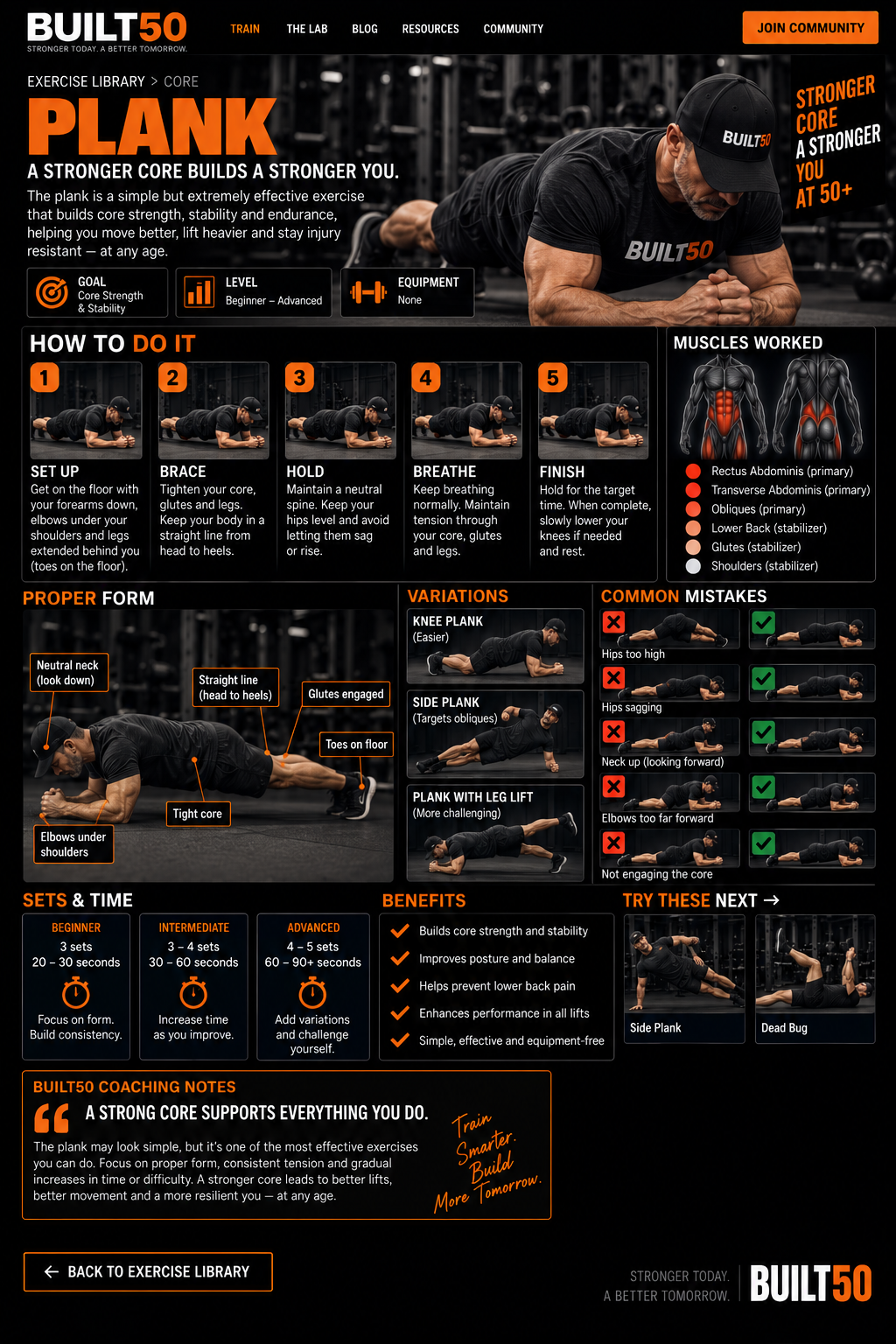
Place your forearms on the floor with your elbows beneath your shoulders. Extend your legs behind you, brace your core and glutes, and maintain a straight line from your head through your hips to your heels.
Muscles Worked
- Rectus abdominis — primary core muscle
- Transverse abdominis — deep core stabilization
- Obliques — trunk stabilization
- Glutes — hip and pelvic stability
- Shoulders — upper-body stabilization
- Lower back — trunk stabilization
Common Plank Mistakes
Common mistakes include allowing the hips to sag, raising the hips too high, looking forward instead of maintaining a neutral neck, holding the breath and continuing the set after proper body position has been lost.
Plank Sets and Hold Times
Start with hold times you can perform with excellent position. Short, high-quality sets are more useful than extending a plank after your form begins to break down. Gradually increase the duration or difficulty as your core strength improves.
Plank Variations
Useful variations include knee planks, side planks, high planks and planks with controlled leg lifts. Choose a variation that allows you to maintain good alignment while providing enough challenge to progress.